Starting From the Other Side
Throughout my cybersecurity experience, I’ve worked with offensive security frameworks such as Cobalt Strike and Metasploit. While learning to operate these tools, I became increasingly interested in the infrastructure behind them.
I wanted to understand how commands travel between systems, how agents communicate with an operator, and what it takes to build that functionality from the ground up.
That curiosity eventually became Ashborne.
The Idea
Ashborne is a self-hosted Command and Control (C2) platform designed for authorized adversary-emulation environments.
My goal was to create a centralized operator console capable of managing enrolled agents, executing structured tasks, gathering system information, and maintaining an audit trail.
Rather than relying on disconnected scripts, I wanted an organized platform where operations could be managed and observed through a single interface.
The Part Nobody Sees
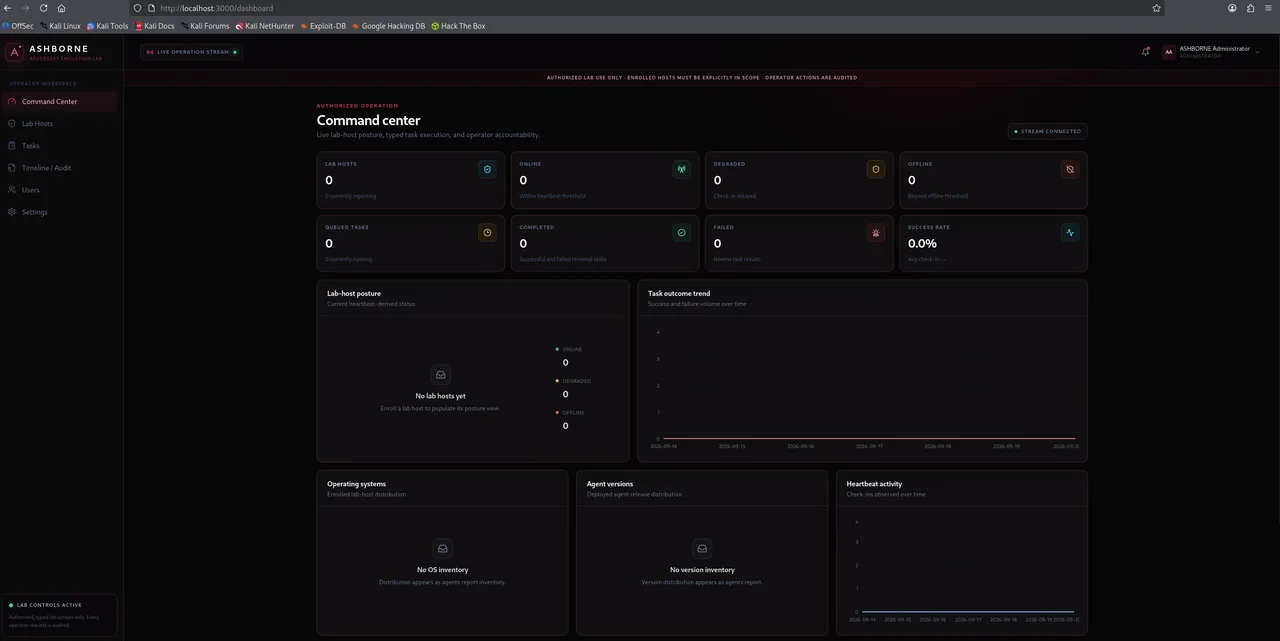
One thing I quickly learned was that executing commands is only a small part of building an operational platform.
Authentication, communication between components, task management, error handling, and agent connectivity all require careful consideration. Building these systems helped me appreciate the software engineering involved in offensive security infrastructure.
I also integrated Kali Linux into the operator workflow, allowing me to manage controlled security testing activities from a centralized environment.
Why I Built It
I didn’t build Ashborne to compete with established offensive security frameworks. I built it because I wanted a deeper understanding of how they function.
Developing my own platform pushed me to work through networking, application architecture, permissions, and the challenges of coordinating multiple systems.
I deliberately focused its capabilities on controlled lab operations, prioritizing visibility, accountability, and opportunities to experiment.
What’s Next
Ashborne remains an ongoing project. I plan to continue improving its task orchestration, system visibility, and overall operator experience as I develop my software engineering and cybersecurity skills.
There’s still plenty I want to explore, and having a platform I built myself gives me the flexibility to do that.
Project: Ashborne on GitHub
Final Thoughts
Building Ashborne gave me a different perspective on offensive security tooling.
Using an existing framework teaches you how to operate it. Building one forces you to understand the engineering decisions that make those operations possible.
That distinction is what made this project worthwhile to me.